Hedy's Folly: The Life and Breakthrough Inventions of Hedy Lamarr, the Most Beautiful Woman in the World by Richard Rhodes
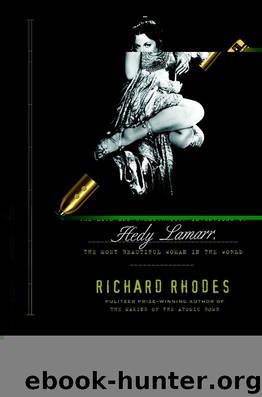
Author:Richard Rhodes [Rhodes, Richard]
Language: eng
Format: mobi
Tags: Biography & Autobiography, Science & Technology, Entertainment & Performing Arts, Women
ISBN: 9780385534390
Google: 3adUhjzh7L8C
Amazon: B004QZ9ZP6
Publisher: Vintage
Published: 2011-11-28T11:00:00+00:00
In a radio communication system comprising a radio transmitter tunable to any one of a plurality of frequencies and a radio receiver tunable to any one of said plurality of frequencies, the method of effecting secret communication between said stations which comprises simultaneously changing the tuning of the transmitter and receiver according to an arbitrary, nonrecurring pattern.
This carefully drafted claim deliberately avoids specifying the mechanism for “simultaneously changing the tuning.” It does so to encompass as much territory as possible within the patent’s boundaries. Writing a patent broadly is part of the strategy of patent claiming. A system of whistles and tuning forks or a system of flashing lights and light sensors might serve as frequency-hopping systems. Because of the broad language of the claim, all would be covered by Hedy and George’s pioneering patent.
An old and classic legal text, Walker on Patents, condenses many court decisions into a description of what constitutes a patentable invention:
An invention is the result of an inventive act; it consists in conceiving an idea and reducing it to practice. An invention is the product of original thought; it is a concept, a thing evolved from the mind. It involves the spontaneous conception or “happy thought” of some idea not previously present in the mind of the inventor; it is the creation of something which did not exist before. Such is the mental part of the inventive act.
But the “mental part” of an invention is not patentable by itself. The new idea needs a physical embodiment. In the jargon of patent law, constructing that embodiment is called reducing to practice:
An invention is not complete by the mere conception of the idea; there must be something more than vague notions of some mode of application of the idea. Such idea is a mere conjecture; it creates nothing until it is reduced to practice and embodied in tangible form.
There’s an obvious tension in inventing between concept and embodiment. The inventor wants a patent framed as broadly as possible, to dominate as many variations of his invention as possible, giving him the right to demand a royalty from the would-be developers of those variations. But he must reduce his new idea to practice by embodying it in a mechanism or a material to qualify for a patent in the first place. A textbook on inventing explains:
The invention is not the specimen or set of plans that the inventor will have made after he has been working on his invention for a while; it is the idea of which this embodiment is the result. It will do the inventor no particular good to get a patent on the specific embodiment, because another inventor might start with the same idea and work it out in an entirely different form. If the inventor gets a patent with claims that describe just his own particular structure and no others, his patent will dominate just that particular structure, and no others. But some other embodiments of his idea might be as good as or better than his, in which case his patent would not have much value.
Download
This site does not store any files on its server. We only index and link to content provided by other sites. Please contact the content providers to delete copyright contents if any and email us, we'll remove relevant links or contents immediately.
Cecilia; Or, Memoirs of an Heiress — Volume 2 by Fanny Burney(31959)
Cecilia; Or, Memoirs of an Heiress — Volume 3 by Fanny Burney(31945)
Fanny Burney by Claire Harman(26607)
We're Going to Need More Wine by Gabrielle Union(19052)
Plagued by Fire by Paul Hendrickson(17417)
All the Missing Girls by Megan Miranda(16047)
Cat's cradle by Kurt Vonnegut(15363)
For the Love of Europe by Rick Steves(14161)
Bombshells: Glamour Girls of a Lifetime by Sullivan Steve(14081)
Leonardo da Vinci by Walter Isaacson(13340)
4 3 2 1: A Novel by Paul Auster(12401)
The remains of the day by Kazuo Ishiguro(9004)
Adultolescence by Gabbie Hanna(8930)
Note to Self by Connor Franta(7673)
Diary of a Player by Brad Paisley(7585)
Giovanni's Room by James Baldwin(7352)
What Does This Button Do? by Bruce Dickinson(6210)
Ego Is the Enemy by Ryan Holiday(5455)
Born a Crime by Trevor Noah(5385)
